




A magnitude 6.0 earthquake beneath Susitna, Alaska, was felt by thousands of Alaskans at about 8:12 am on November 27, 2025, Thanksgiving morning. Reports from Homer to Valdez and north to Fairbanks came from residents who were shaken awake. Because of the earthquake’s depth (about 40 mi, or 70 km—Figure 2), even those closest to the epicenter reported minimal damage.
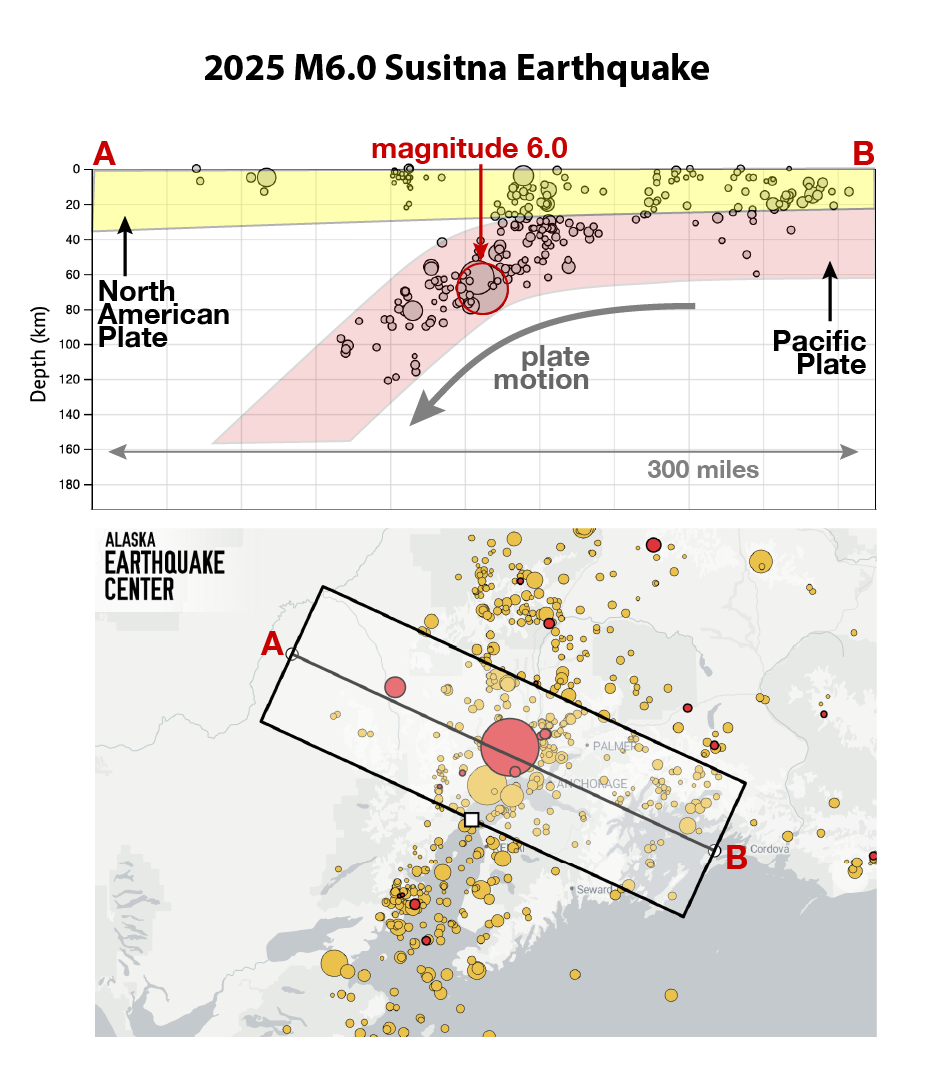
Annotated cross section of the 2025 M6.0 Susitna Earthquake from the Earthquake Center’s interactive recent earthquakes map.
Top: The Pacific Plate (pink) underthrusts the North American Plate (yellow). This earthquake occurred inside the down-going Pacific Plate. This plate is subjected to considerable stresses as it is pulled deep into the earth and as it bends to accommodate this motion. This type of “intraslab earthquake” is a common source of seismic activity felt in Southcentral Alaska.
Bottom: The last two weeks of earthquakes in Alaska marked in yellow, earthquakes from the past 24 hours in red. Circles are scaled by magnitude. The large red circle makes the epicenter of the M6.0. ‘A’ and ‘B’ mark the edges of the cross section shown in the top panel. (Credit: Michael West)
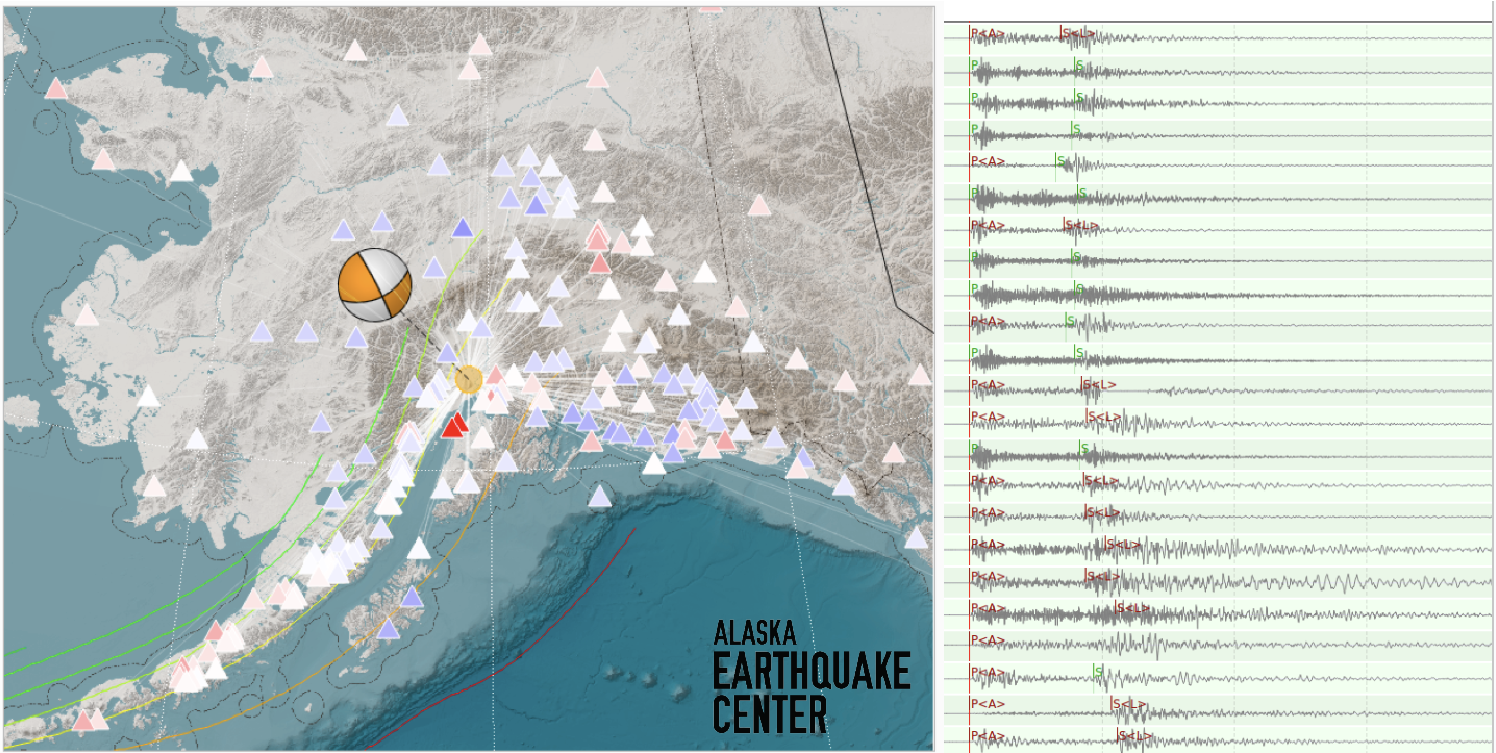
Rapid analysis of the M6 Susitna earthquake using our new Gen3 system. The focal mechanism was available less than five minutes after detection, illustrating the system’s advanced real-time capabilities. (Credit: Derreck Gossett)
This event fell outside the aftershock region of the 2018 M7.1 Earthquake, so it is not associated with that larger quake. The Susitna Earthquake likely occurred within the subducting Pacific Plate as it moves beneath the North American Plate. This type of earthquake is relatively common within southern Alaska (check out our radio segment about it.)
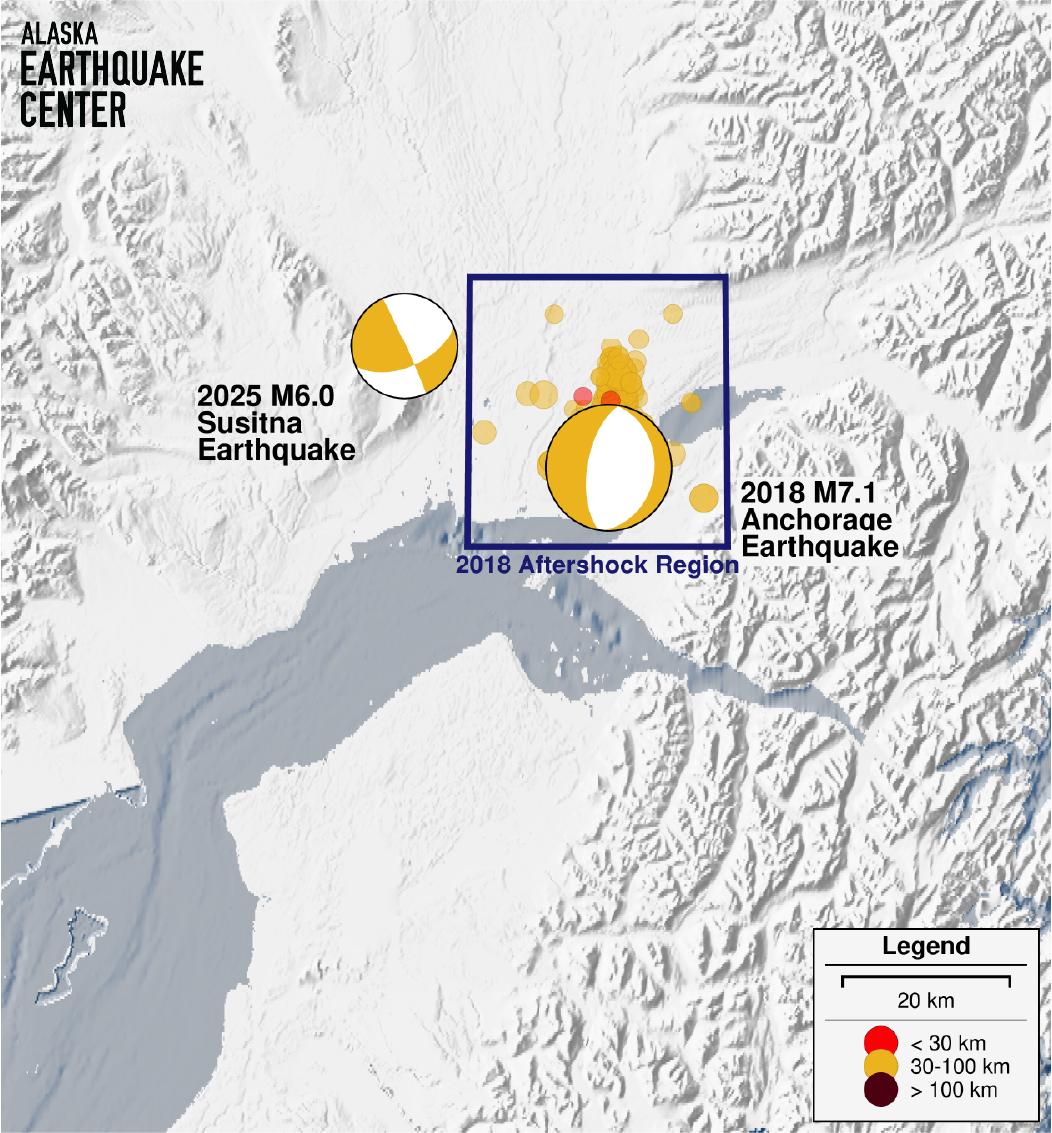
Comparison of the 2018 M7.1 mainshock aftershock sequence with today’s M6.0 Susitna sequence. The Susitna earthquake lies outside of the 2018 aftershock zone, and its focal mechanism indicates a different faulting style. (Credit: Sarah Noel)
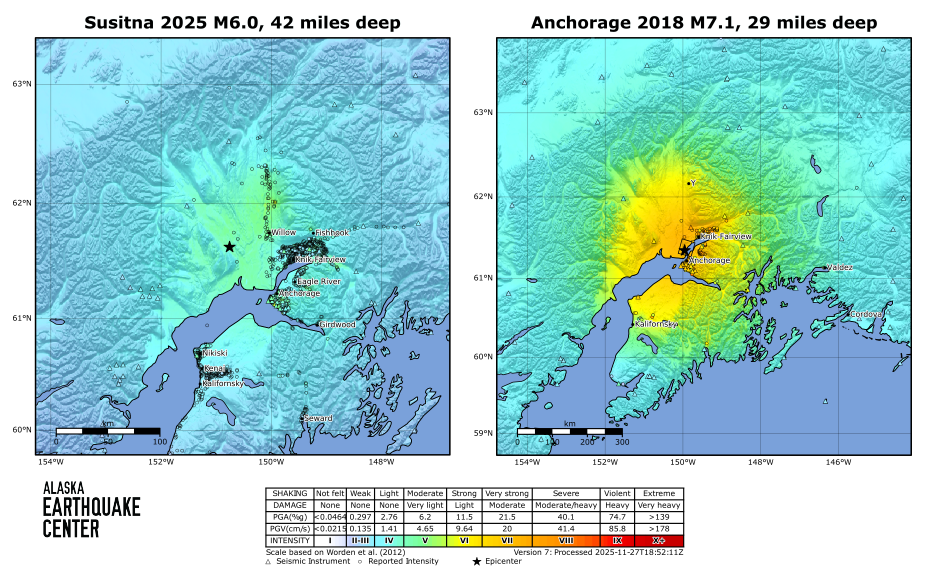
Side-by-side comparison of the Susitna 2025 and the Anchorage 2018 intensity maps. Intensities for this earthquake are about 2–3 levels lower than the Anchorage earthquake. Despite having a lower magnitude and being almost twice as deep, the event was still widely felt throughout Interior and Southcentral Alaska. In fact, this event received almost three times as many felt reports (small colored dots on the map) about 6500 vs 2300! (Credit: Alex Fozkos)
While the proximity to the anniversary of the 2018 Anchorage Earthquake seems notable, there is no time of year when deep earthquakes are more likely to occur, and the late November timing of this earthquake is merely an interesting coincidence. Additionally, the type of earthquake was quite different, with the Susitna event resulting from lateral slip within the subducting plate, while the 2018 Anchorage event resulted from the typical thrusting motion of the Pacific Plate.
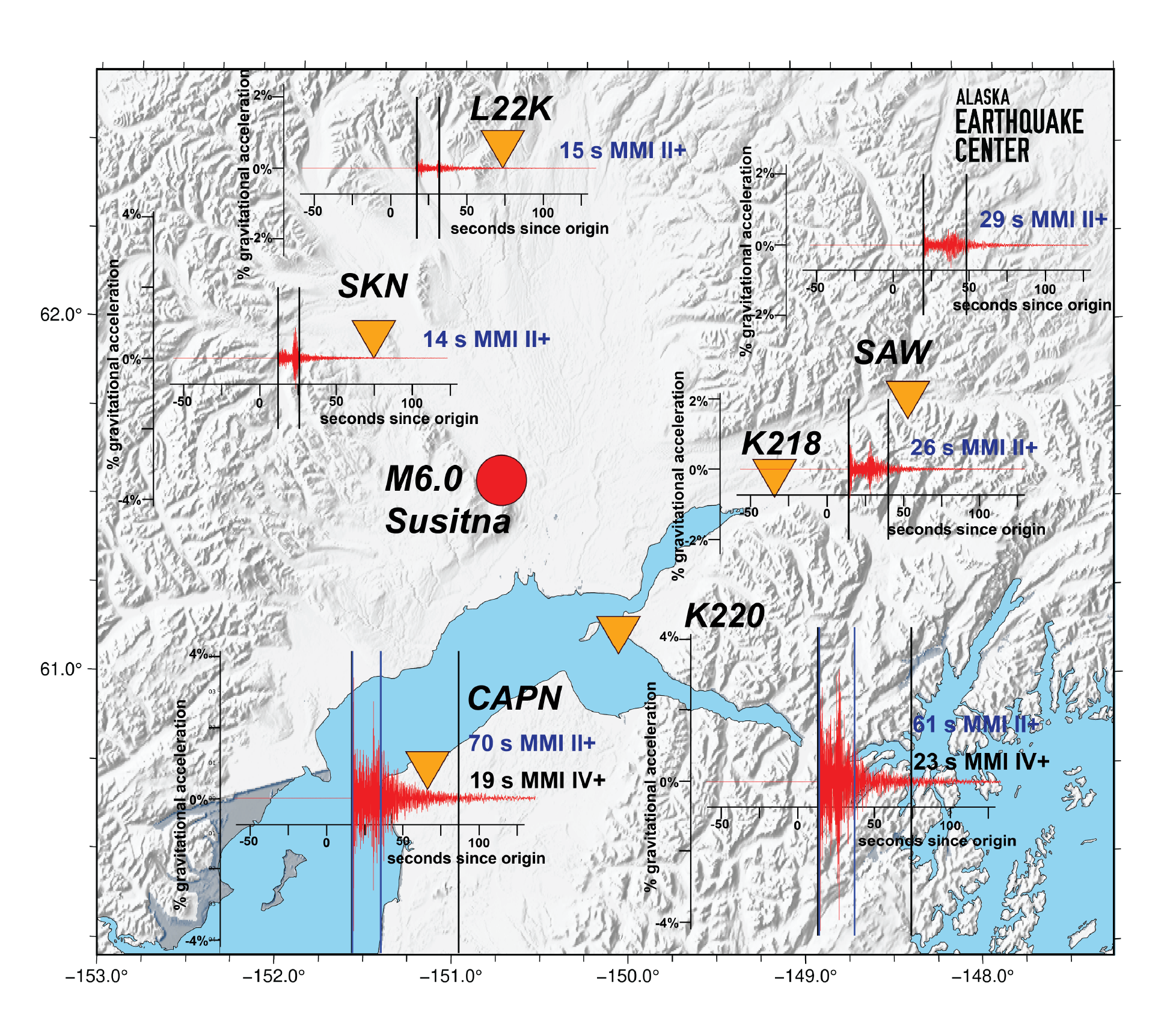
Map of the region where earthquake shaking was felt, with seismograms from the closest Alaska Earthquake Center seismic stations. Stations CAPN and K220 show how a sediment filled basin can generate stronger and longer shaking. (Credit: Cade Quigley)
Learn More
Magnitude 6.0 Susitna Earthquake Shakes Up Thanksgiving